

Key Takeaways
- Prepare outdoor plumbing before the first sustained freeze, not after a hose or faucet has already frozen.
- Disconnecting hoses and draining exterior lines can help prevent trapped water from damaging faucets and connected pipes.
- Chicago and Milwaukee homeowners should pay close attention to garages, crawlspaces, exterior walls, basements, and irrigation equipment.
- A frozen pipe may not reveal a crack until temperatures rise and the ice melts.
- Checking for leaks after a cold snap is as important as winterizing beforehand.
Lake Michigan weather can turn quickly in Chicago, Illinois, and Milwaukee, Wisconsin. A mild fall afternoon may give way to freezing overnight temperatures, leaving little time to address a hose, sprinkler line, or exposed faucet. Planning is usually simpler than responding to a leak after the first hard freeze. For homeowners who find a damaged faucet, a frozen outdoor line, or unexplained water near an exterior wall, an outside plumber in Chicago can help assess whether the trouble is limited to a fixture or has affected plumbing inside the home. The best first step, however, is removing water from vulnerable outdoor components before cold air settles in.
- Key Takeaways
- Why the First Freeze Deserves Attention
- When to Begin Your Freeze Check
- Outdoor Plumbing Areas Most at Risk
- How to Prepare Outdoor Faucets and Hoses
- What to Do With Irrigation and Seasonal Lines
- How to Protect Exposed Pipes and Meters
- Warning Signs of Freeze Damage
- Common Winterization Mistakes
- A Simple First-Freeze Checklist
- Frequently Asked Questions
- Does a faucet cover prevent frozen pipes?
- Should an outdoor faucet be left dripping?
- What should be done if a pipe is frozen?
- Conclusion
Why the First Freeze Deserves Attention
Water expands when it freezes. If water remains in a closed plumbing section, the resulting expansion can put pressure on pipes, valves, fittings, hose bibbs, and sprinkler components. The visible outdoor faucet is not always the only concern. A short section of supply pipe inside an exterior wall, attached garage, or unheated utility space may be the part that freezes first. In older brick homes, bungalows, two-flats, and newer suburban construction alike, cold air can reach plumbing through foundation openings, drafty garage walls, crawlspaces, and poorly sealed service penetrations. Damage can remain hidden while the pipe is frozen, then become apparent as dripping, staining, or pooling water during a thaw.
When to Begin Your Freeze Check
Start the inspection when the forecast begins showing overnight temperatures near freezing. Do not wait for snow, an official warning, or a frozen hose to signal that it is time. Conditions vary across the region, but the National Weather Service lists October 19 as the normal first autumn date at or below 32 degrees Fahrenheit at Chicago O’Hare, based on data from 1991 through 2020. Use local first-freeze information as a planning reference, not as a guarantee for every neighborhood or property.
Outdoor Plumbing Areas Most at Risk
Walk the entire property rather than focusing only on the front hose bibb. Check the following areas:
- Outdoor faucets, hose bibbs, and utility sinks
- Garden hoses, splitters, timers, spray nozzles, and wands
- Exposed supply pipes near foundations or exterior walls
- Irrigation valves, backflow preventers, and sprinkler lines
- Pool fill lines, outdoor wash stations, and seasonal water connections
- Water meters in basements, garages, exterior closets, or meter pits
- Plumbing routed through sheds, crawlspaces, and attached garages
How to Prepare Outdoor Faucets and Hoses
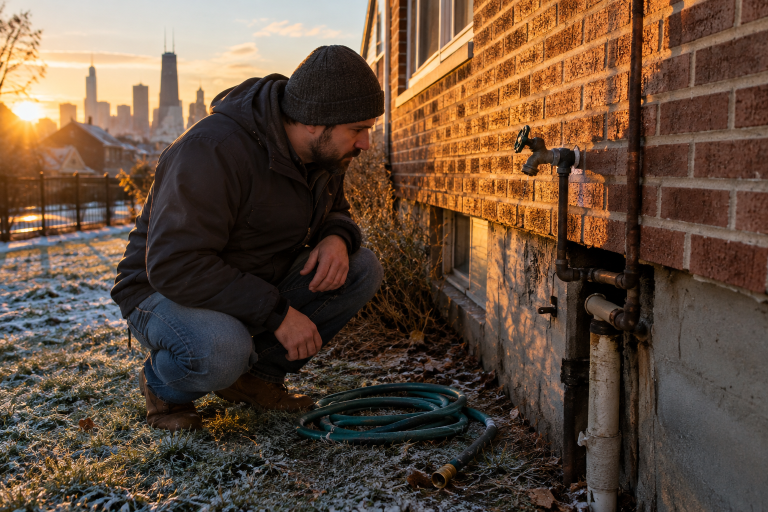
A straightforward routine can reduce the chance of water being trapped where it does not belong:
- Disconnect every hose from every outdoor faucet.
- Drain the hoses fully and store them in a dry location.
- Remove attachments such as timers, splitters, nozzles, and spray wands.
- Close the interior shutoff valve for the exterior faucet, if your home has one.
- Open the outdoor faucet briefly to let remaining water drain.
- Close the faucet after drainage is complete.
- Install a properly fitted faucet cover if appropriate for the fixture.
Leaving a hose connected can interfere with drainage and leave water inside the faucet assembly or connected piping. A faucet cover may reduce direct wind exposure, but it cannot replace an interior shutoff and proper drainage.
What to Do With Irrigation and Seasonal Lines
Sprinkler systems need more than a quick shutoff. Closing the supply valve does not necessarily remove water from low points, valve bodies, backflow devices, or underground branches. Follow the irrigation equipment manufacturer’s winterization instructions. Some systems can be drained through designated valves, while others require a qualified professional to perform a controlled blowout procedure.
- Close the irrigation supply valve.
- Drain accessible equipment and above-ground connections.
- Protect exposed backflow assemblies according to local requirements.
- Remove water from temporary outdoor lines and wash stations.
- Mark shutoff locations to make spring startup easier.
How to Protect Exposed Pipes and Meters
Pipe insulation and approved heat tape can slow heat loss in vulnerable areas, but neither should be treated as a substitute for draining seasonal plumbing. Seal obvious drafts, keep warm air circulating, avoid blocking heat from pipes located near exterior walls, and keep indoor plumbing warm. Water meters also deserve attention, particularly in cold basements and utility rooms. Milwaukee’s guidance for frozen pipes and water meters advises eliminating cold drafts, insulating vulnerable pipes, and avoiding open flames when thawing. Never use a torch, grill, or other flame near plumbing. If a frozen pipe is hidden inside a wall or close to electrical equipment, contact a qualified professional.
Warning Signs of Freeze Damage
- Little or no water from a faucet that normally works
- Weak water pressure in one part of the home
- A bulging, cracked, or visibly damaged pipe
- Water stains on walls, ceilings, or floors
- Dripping or pooling water near an exterior faucet
- Unusual sounds inside a wall after temperatures rise
- A faucet that will not open, close, or stop dripping normally
If a burst is suspected, shut off the water supply when it is safe to do so and inspect the affected area. The leak may only become visible after the ice has thawed.
Common Winterization Mistakes
- Leaving hoses attached through the first cold nights
- Assuming a faucet cover protects the entire supply line
- Forgetting plumbing behind a garage, shed, or enclosed porch
- Skipping irrigation drainage steps
- Using unsafe heating devices near water or electrical connections
- Ignoring a drafty crawlspace or basement utility area
- Failing to inspect the property after a thaw
A Simple First-Freeze Checklist
- Review the forecast for several consecutive cold nights.
- Disconnect, drain, and store outdoor hoses.
- Shut off and drain exterior faucet lines when possible.
- Winterize irrigation equipment and seasonal water lines.
- Inspect exposed pipes, fittings, valves, and meter areas.
- Seal drafts near garages, crawlspaces, and utility openings.
- Locate the main water shutoff before an emergency occurs.
- Check for drips, stains, and pressure changes after the cold snap ends.
Frequently Asked Questions
Does a faucet cover prevent frozen pipes?
A cover can help shield the faucet from direct cold air, but it does not protect all connected plumbing. Draining the line and using an interior shutoff, when available, are more important steps.
Should an outdoor faucet be left dripping?
Dripping is not a substitute for winterizing an outdoor faucet. Seasonal outdoor lines should be shut off and drained where possible. For vulnerable indoor pipes during severe cold, follow local utility guidance and monitor drainage carefully.
What should be done if a pipe is frozen?
Open the affected faucet, reduce drafts, and use safe warming methods only when the pipe is accessible and there is no sign of a leak. Avoid open flames. Shut off water if a break is suspected, and seek professional help for hidden, damaged, or difficult-to-reach pipes.
Conclusion
In Chicago and Milwaukee, completing a first-freeze check is an important part of preparing a home for colder weather. As temperatures begin to drop, homeowners should disconnect garden hoses, drain exterior faucets and exposed water lines, shut off outdoor water supplies where appropriate, and protect irrigation equipment from freezing. It is also worth checking crawl spaces, basements, garages, and other areas where plumbing may be exposed to cold air. Insulating vulnerable pipes and sealing gaps that allow drafts inside can provide additional protection. These preventive steps may help reduce the risk of frozen or burst pipes, unexpected water damage, and costly winter repairs. Rather than waiting for the first major cold snap, start preparing when fall temperatures begin to decline. Once temperatures rise above freezing, inspect outdoor faucets and plumbing connections for leaks or other signs of damage.

