

The story of North Carolina’s development is inextricably linked to the unseen infrastructure beneath its surface. From the early days of rudimentary water and waste systems to the sophisticated networks of May 2026, the evolution of subsurface utilities has mirrored the state’s remarkable growth. Historically, infrastructure development was often reactive, addressing immediate needs as communities expanded. Today, with rapid urban expansion and increasing population density, the approach has become proactive, focusing on resilient, high-capacity utility modernization. The Piedmont area, in particular, has experienced significant development, necessitating continuous upgrades and expansion of its underground systems.
- Core Services in Underground Utility Construction
- Advanced Technologies and Trenchless Methods
- The Role of Technology in Underground Utility Construction
- Precision in Underground Utility Construction
- Safety, Quality, and Regulatory Compliance
- Strategic Planning and Project Delivery
- Frequently Asked Questions about Subsurface Utilities
- What are the primary benefits of trenchless utility installation?
- How do contractors manage utility installation at extreme depths?
- What is the difference between a gravity sewer and a force main?
- Conclusion
The demand for reliable water, sewer, and communication services drives innovation in the underground utility sector. As our cities become smarter and more interconnected, the complexity of these networks grows exponentially. This requires contractors to not only understand traditional methods but also to embrace cutting-edge technologies to meet the evolving needs of municipalities, commercial developers, and residential communities. The goal is to build foundations that are not just strong for today, but future-proof for generations to come.

Modern utility excavation sites are complex operations, showcasing the precision and planning required for subsurface infrastructure projects.
The layers of underground utility systems are intricate and interdependent. From potable water lines and sanitary sewer mains to stormwater drainage and fiber optic cables, each component plays a vital role in urban functionality. Understanding their placement, interconnections, and maintenance requirements is paramount for any successful project.
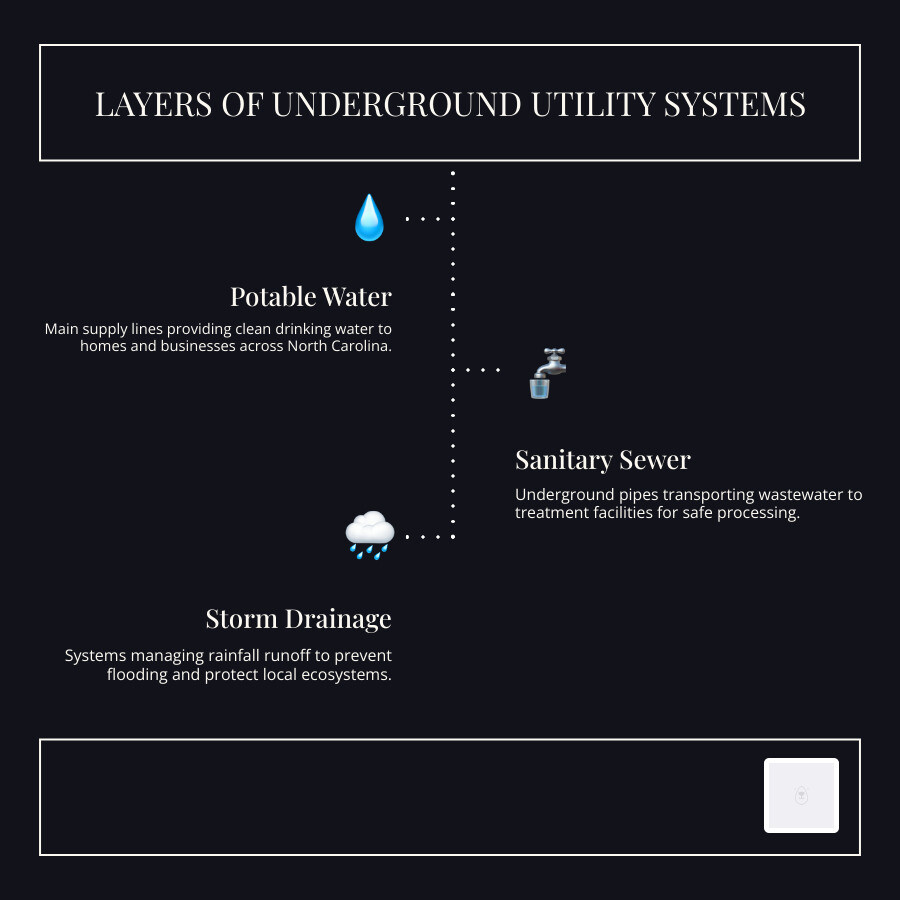
This infographic illustrates the typical layering of various utility systems beneath urban landscapes, highlighting the need for meticulous planning and execution.
Core Services in Underground Utility Construction
Underground utility contractors in North Carolina offer a comprehensive suite of services essential for developing and maintaining modern infrastructure. These services are critical for both new construction and the rehabilitation of aging systems, ensuring communities have access to vital resources.
At the heart of these operations is the installation of water transmission and sewer mains. These large-diameter pipes are the lifelines of any community, transporting clean water to homes and businesses, and efficiently removing wastewater. Contractors are adept at installing these systems, often dealing with challenging terrains and existing infrastructure. For instance, companies like B.R.S., Inc. have a long history in the Piedmont area, boasting extensive mileage of both sewer and water piping installations, reflecting deep expertise in these fundamental areas.
Storm drainage systems are another crucial service, designed to manage rainwater runoff and prevent flooding. This includes the installation of various pipe materials such as Reinforced Concrete Pipe (RCP), High-Density Polyethylene (HDPE), and specialized stormwater management solutions like StormTech chambers. Effective stormwater infrastructure is vital for protecting property and the environment, and contractors often work closely with engineers to design and implement robust systems. For more on this, consider exploring resources on Storm Drain Pipe Installation and Stormwater Infrastructure.
Beyond gravity-fed systems, contractors also specialize in sanitary sewer and force mains. While gravity sewers rely on slope to move wastewater, force mains are pressurized systems that use pumps to convey sewage over flat terrain or uphill, often connecting to pump stations and lift stations. These facilities are complex, requiring specialized mechanical and electrical expertise for their installation and maintenance. D.H. Griffin Infrastructure, for example, has a proven track record of successfully contracting and installing multi-million dollar turnkey pump station projects, demonstrating the scale and complexity involved.
In the realm of communications and power, contractors install duct banks and electrical conduit systems. These protect vital underground power cables and telecommunication lines, including fiber optics, from environmental damage and physical disruption. The increasing demand for high-speed internet and reliable power grids makes these services indispensable. For specific insights into this area, further reading on Conduit for Underground Power and Underground Power Cable Installation can be valuable.

Installation of large diameter pipes requires heavy machinery and skilled crews, demonstrating the scale of underground utility projects.
Here’s a list of common pipe materials used in underground utility construction:
- High-Density Polyethylene (HDPE)
- Polyvinyl Chloride (PVC)
- Ductile Iron Pipe (DIP)
- Reinforced Concrete Pipe (RCP)
- Corrugated Metal Pipe (CMP)
- Vitrified Clay Pipe (VCP)
- Steel Pipe
Contractors handle a wide range of projects, from routine installations to emergency repairs. Abernethy Contracting, for instance, focuses on underground utilities associated with site preparation for commercial, industrial, and large-scale residential developments, emphasizing the importance of correct initial installation to prevent future issues. This dedication to quality ensures the long-term reliability of North Carolina’s critical infrastructure.
Advanced Technologies and Trenchless Methods
The underground utility contracting industry in North Carolina is continually evolving, driven by advancements in technology and a growing emphasis on minimizing environmental impact and surface disruption. Modern contractors leverage a suite of innovative tools and techniques to deliver projects more efficiently, safely, and cost-effectively.
The Role of Technology in Underground Utility Construction
One of the most significant technological shifts has been the widespread adoption of trenchless installation methods. These techniques allow for the installation, replacement, or repair of underground pipes and conduits without the need for extensive open-cut excavation, dramatically reducing surface disturbance. Key trenchless methods include:
- Horizontal Directional Drilling (HDD): Often referred to simply as directional boring, HDD is a steerable trenchless method of installing underground pipes, conduits, or cables in a shallow arc along a prescribed bore path by using a surface-launched drilling rig. This method is particularly beneficial for crossing roads, rivers, wetlands, and other obstacles where open trenching is impractical or environmentally sensitive. Elite Underground Utility, for example, highlights directional boring for its precision and minimal environmental impact. For a deeper dive into these methods, explore resources on Trenchless Utility Installation Carolinas.
- Auger Boring: This method uses a rotating auger to remove spoil while a casing pipe is simultaneously advanced into the ground. It’s suitable for larger diameter installations, particularly under railways or highways.
- Tunneling: For very large diameter pipes or where ground conditions are challenging, tunneling techniques can be employed, creating a subterranean passage for utility installation.
These methods offer significant benefits, including reduced restoration costs, minimal traffic disruption, environmental protection, and often faster project completion, especially in congested urban areas.
Contractors also employ sophisticated precision tools for site preparation and execution. GPS-guided grading and Trimble machine control systems are now standard on many large projects. These technologies allow for incredibly accurate earthmoving, ensuring that grades are precisely met and material movement is optimized, leading to greater efficiency and reduced material waste. The use of these systems contributes to the overall precision of underground utility construction, from initial excavation to final backfill.
Furthermore, project documentation has been revolutionized. Many contractors now utilize 4K video and drone footage to monitor progress, document conditions, and ensure quality control throughout the project lifecycle. This detailed visual record enhances transparency and provides valuable insights for both the contractor and the client.
Feature Open-Cut Trenching Trenchless Methods (e.g., HDD) Surface Disruption High (excavates entire path) Low (entry/exit pits only) Traffic Impact Significant (road closures, detours) Minimal (localized impact) Environmental Impact Higher (soil disturbance, habitat disruption) Lower (minimal ecological footprint) Cost Can be lower for simple, shallow installations Can be higher initially, but lower overall due to reduced restoration Speed Faster for short, direct runs Often faster for complex, long, or obstructed runs Obstacle Avoidance Difficult (requires removal or rerouting) Excellent (can navigate around existing structures) This table provides a comparative overview of traditional open-cut trenching versus modern trenchless installation methods, highlighting the advantages of each approach in different scenarios.
Precision in Underground Utility Construction
The challenges of underground utility construction often extend beyond simple installation. Contractors frequently encounter scenarios requiring extreme precision and specialized expertise. This includes extreme depth excavation, where utilities need to be installed or repaired at significant depths. Some projects, like the construction of large pump stations, can involve excavating and building structures up to 35 feet deep, often requiring specialized shoring systems and structural support to ensure worker safety and structural integrity. D.H. Griffin Infrastructure’s experience with 35-foot-deep cast-in-place duplex wet wells exemplifies this capability.
Working with thermal utilities and medium voltage work also demands a high level of specialized knowledge and adherence to stringent safety protocols. These systems are critical for industrial and institutional clients and require contractors with specific certifications and experience.
To further enhance safety and efficiency, contractors employ techniques like vacuum excavation for precise digging around existing utilities, minimizing the risk of damage. Utility locating and subsurface utility engineering (SUE) are becoming standard practices, using ground-penetrating radar and other technologies to accurately map existing underground infrastructure before any digging begins. This proactive approach helps prevent costly strikes and project delays.
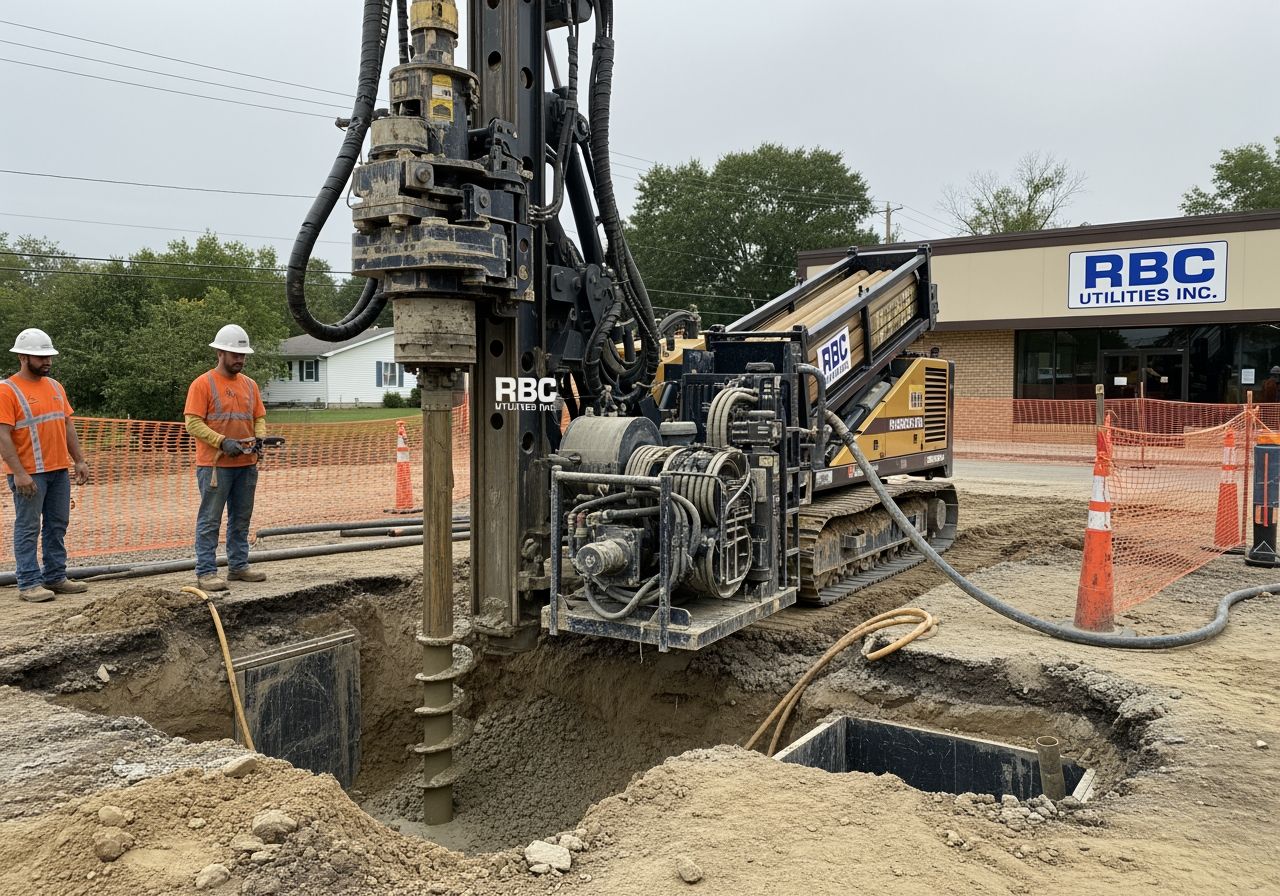
A directional boring machine at work, illustrating the advanced technology used to install utilities with minimal surface disturbance.
The integration of these advanced technologies and methods allows North Carolina’s underground utility contractors to tackle increasingly complex projects, from installing new infrastructure in densely populated areas to performing critical repairs under challenging conditions.
Safety, Quality, and Regulatory Compliance
In the high-stakes world of underground utility construction, safety, quality, and strict adherence to regulatory compliance are not merely best practices—they are non-negotiable foundations of every project. The inherent risks associated with excavation, heavy machinery, and working with essential services demand an unwavering commitment to these principles.
Safety is paramount. Contractors in North Carolina operate under rigorous OSHA standards, which dictate everything from trenching and excavation procedures to personal protective equipment (PPE) requirements. A key component of OSHA compliance is the requirement for a Certified Competent Person to be on-site during active excavation. This individual is specially trained to identify and mitigate hazards, ensuring that all workers are protected. Companies like Carolina Conduit Systems emphasize their full-time Safety Officer and the requirement for field management to hold Competent Person certifications, underscoring the industry’s dedication to a robust safety culture.
Training is continuous, covering all aspects of trenching hazards and excavation safety. This includes understanding soil mechanics, proper shoring techniques, atmospheric monitoring in confined spaces, and emergency response procedures. The goal is to create a work environment where every team member is empowered to identify and address potential risks.
Proper trench shoring and safety equipment are essential for protecting workers in excavation sites, highlighting the industry’s commitment to safety.
Beyond worker safety, environmental protection is a critical aspect of quality and compliance. Erosion control measures are implemented on every site to prevent soil runoff and protect waterways. This includes the strategic placement of silt fences, construction of sediment basins, and the use of riprap to stabilize disturbed areas. These measures are not just good practice; they are often mandated by state and local environmental regulations, ensuring that construction activities have minimal impact on the surrounding ecosystem.
Quality assurance extends to the utilities themselves. For water systems, hydrostatic testing is performed to verify the integrity of newly installed pipes, ensuring they can withstand operational pressures without leaks. Following successful testing, water lines undergo disinfection protocols to eliminate any contaminants before being connected to the public supply. Similarly, sewer lines are tested for leaks and proper flow.
For projects involving municipal infrastructure, contractors must navigate complex permitting processes and ensure successful municipal tie-ins. This requires meticulous planning and coordination with local authorities to ensure that new installations seamlessly integrate with existing systems and meet all local codes and standards. The focus is always on long-term reliability and performance, ensuring that the infrastructure serves the community effectively for decades. This holistic approach to environmental stewardship and regulatory adherence defines the leading underground utility contractors in North Carolina.
Strategic Planning and Project Delivery
The success of any underground utility project in North Carolina hinges not only on technical expertise but also on sophisticated strategic planning and efficient project delivery methods. Contractors are increasingly adopting collaborative approaches to streamline complex projects, ensuring they are completed on time, within budget, and to the highest quality standards.
One such approach is Design-Build, where a single entity assumes responsibility for both the design and construction phases of a project. This integrated method fosters greater collaboration between designers and builders, often leading to faster project completion, reduced costs, and fewer change orders. It allows for innovative solutions to be incorporated early in the process, optimizing constructability.
Another effective delivery method is Construction Manager at Risk (CMAR). Under CMAR, a construction manager is involved from the project’s inception, providing pre-construction services like cost estimating, scheduling, and value engineering. The CM then commits to delivering the project within a guaranteed maximum price (GMP), assuming the risk for cost overruns. This method offers clients greater cost certainty and allows for early contractor input, which can be invaluable for complex underground utility work.
Many contractors offer turnkey site development services, providing a comprehensive solution from initial land clearing and mass grading to the final installation of all underground utilities and surface finishes. This integrated approach simplifies project management for clients, as they deal with a single point of contact for multiple phases of work. These full-service capabilities often include extensive pre-construction services, where contractors assist with planning, budgeting, and scheduling before ground is even broken.
Effective utility coordination is paramount, especially in areas with existing subsurface infrastructure. This involves meticulous planning to identify, locate, and protect existing utilities, preventing costly strikes and minimizing disruptions. Contractors often employ subsurface utility engineering (SUE) to gain a precise understanding of the underground environment, mitigating potential conflicts. When conflicts do arise, skilled contractors excel at conflict resolution, finding practical and efficient solutions that keep the project moving forward.
The initial phases of site preparation are critical. Mass grading involves moving large volumes of earth to achieve the desired contours and elevations for the site, preparing it for construction. Following grading, site stabilization techniques are implemented to prevent erosion and ensure a stable foundation for future development. Finally, contractors often complete the project with asphalt paving for roads, parking lots, and other surfaces, ensuring a fully functional and aesthetically pleasing outcome.
The ultimate goal of these strategic approaches is to ensure long-term infrastructure reliability. By combining advanced planning, collaborative delivery methods, and meticulous execution, North Carolina’s Underground utility contractors NC are building resilient systems that will serve communities for decades, underpinning the state’s continued growth and prosperity.
Frequently Asked Questions about Subsurface Utilities
Clients often have specific questions regarding the complexities of underground utility projects. Here, we address some of the most common inquiries, providing clarity on benefits, methodologies, and technical distinctions.
What are the primary benefits of trenchless utility installation?
Trenchless utility installation methods, such as horizontal directional drilling (HDD) and pipe bursting, offer a multitude of advantages over traditional open-cut trenching, making them increasingly popular in North Carolina. The primary benefits include:
- Reduced Restoration Costs: By minimizing the amount of surface disturbance, trenchless methods significantly lower the expense and effort required to restore landscaping, roads, and other surface features after utility installation.
- Minimal Traffic Disruption: Projects can often proceed without closing roads or major traffic lanes, reducing inconvenience for commuters and local businesses. This is particularly valuable in urban and densely populated areas.
- Environmental Protection: Less excavation means less soil disturbance, reduced erosion, and a smaller ecological footprint. This is especially important when working near wetlands, rivers, or sensitive natural habitats.
- Faster Project Completion: While the setup for trenchless methods can sometimes take longer, the actual installation phase can often be completed more quickly than extensive open trenching, leading to shorter overall project timelines.
- Ability to Bypass Existing Structures: Trenchless techniques can navigate around existing underground utilities, buildings, and other obstacles, allowing for installations in areas that would be impossible or prohibitively expensive with open-cut methods.
These benefits highlight why trenchless solutions are often the preferred choice for modern underground utility projects, offering efficiency, cost-effectiveness, and environmental responsibility. For more information, you can explore resources on Trenchless Utility Installation Carolinas.
How do contractors manage utility installation at extreme depths?
Installing utilities at extreme depths, sometimes 30-35 feet below the surface, presents unique engineering and safety challenges. North Carolina contractors employ a combination of specialized techniques and stringent safety protocols to manage these complex projects:
- Advanced Shoring Systems: To prevent trench collapse, contractors utilize robust shoring systems, including hydraulic shoring, trench boxes, and sheet piling. These systems are engineered to withstand immense soil pressures and are critical for worker safety.
- Specialized Deep-Reach Excavators: Standard excavators may not have the reach required for extreme depths. Contractors invest in or rent specialized equipment with extended booms and powerful digging capabilities to handle deep excavations efficiently.
- Strict OSHA Compliance: Adherence to OSHA’s excavation standards (29 CFR 1926 Subpart P) is non-negotiable. This includes having a “Competent Person” on-site at all times, ensuring proper sloping, shoring, and access/egress from excavations.
- Groundwater Management: Deep excavations often encounter groundwater. Contractors implement sophisticated dewatering techniques, such as well points or sumps, to keep the work area dry and stable, protecting both the excavation and the installed utilities.
- Precision Dewatering Techniques: Beyond simple pumping, precision dewatering involves carefully managing groundwater levels to prevent settlement of adjacent structures or environmental impacts. This requires hydrogeological expertise and specialized equipment.
Managing extreme depth installations requires meticulous planning, highly skilled personnel, and significant investment in specialized equipment, ensuring both project success and worker safety.
What is the difference between a gravity sewer and a force main?
Understanding the distinction between gravity sewers and force mains is fundamental to wastewater management infrastructure.
- Gravity Flow Requirements: A gravity sewer system relies entirely on the natural slope of the land to transport wastewater from its source to a treatment plant or another collection point. Pipes are laid at a consistent downward gradient, allowing gravity to move the sewage. This method is cost-effective and energy-efficient, as it requires no mechanical pumping. However, it is dependent on suitable topography and can be challenging to implement in flat or undulating terrain. For more details on this, see Sewer Main Line Installation.
- Pressurized Piping Systems: A force main, in contrast, is a pressurized piping system that actively pumps wastewater. It is used in situations where gravity flow is not feasible due to elevation challenges (e.g., needing to move wastewater uphill) or flat terrain that doesn’t allow for sufficient slope. Force mains are connected to pump stations (also known as lift stations), which house powerful pumps that push the wastewater through the pipe.
Key differences and implications include:
- Energy Consumption: Gravity sewers are passive and consume no energy for transport, while force mains require significant energy to operate pumps.
- Pipe Material and Design: Force mains must be designed to withstand internal pressure, often using stronger pipe materials and specific jointing methods. Gravity sewers are designed for flow capacity and structural integrity under soil loads.
- Maintenance Specifications: Force mains require maintenance of mechanical components (pumps, valves), while gravity sewers primarily focus on preventing blockages and ensuring pipe integrity.
- Integration with Pump Stations: Force mains are always part of a system that includes pump station integration, whereas gravity sewers are part of a larger collection network that may eventually feed into a pump station.
Both systems are crucial components of a comprehensive wastewater collection network, each serving specific topographical and engineering requirements.
Conclusion
The intricate world of underground utility construction in North Carolina is a testament to human ingenuity and dedication, forming the silent, yet essential, backbone of our communities. From ensuring reliable water and sewer services to enabling seamless communication and power distribution, the work of underground utility contractors is fundamental to our daily lives and future prosperity.
As we look towards May 2026 and beyond, the industry continues to evolve, embracing advanced technologies like trenchless installation methods and GPS-guided precision to enhance efficiency, minimize environmental impact, and uphold the highest safety standards. The challenges of urban expansion, aging infrastructure, and the demand for sustainable development mean that the role of these specialized professionals will only grow in importance.
By meticulously planning, employing cutting-edge equipment, and adhering to strict regulatory compliance, North Carolina’s underground utility contractors are not just laying pipes and cables; they are building infrastructure longevity, ensuring the future-proofing of our cities, and making a profound community impact. Their commitment to technical expertise and engineering precision guarantees that the unseen foundations beneath our feet are strong, resilient, and ready to support the vibrant growth of the Tar Heel State. Investing in subsurface excellence today is investing in a brighter, more connected, and more sustainable tomorrow.


