

What is PITI in Real Estate? The True Cost of Homeownership
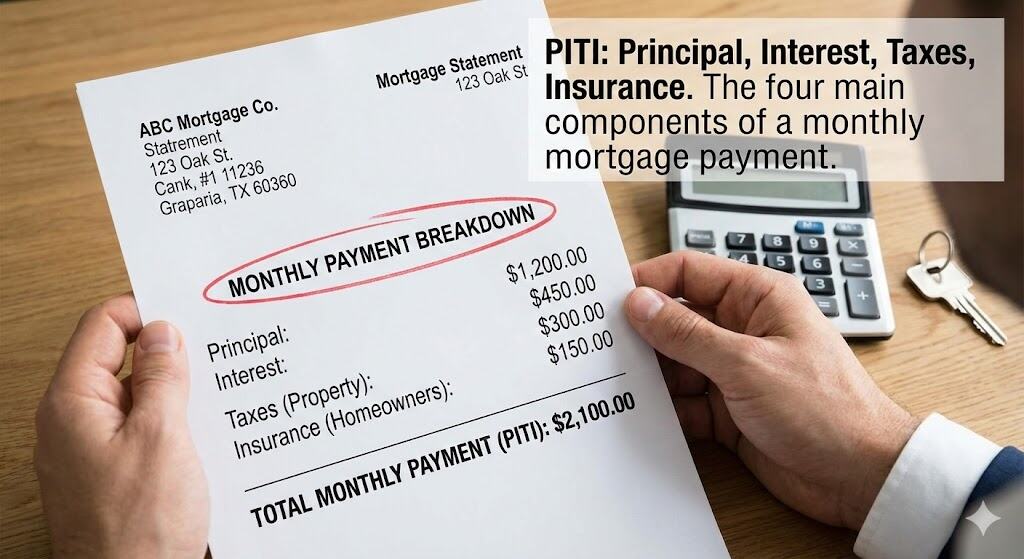
One of the most common shocks for first-time homebuyers occurs at the closing table. They used an online mortgage calculator, which told them their payment would be $1,500. Yet, the lender is asking for $2,100 a month. Where did the extra $600 come from? The answer is PITI.
PITI (pronounced “city” with a P) is the acronym that describes the total monthly cost of owning a home with a mortgage. It stands for Principal, Interest, Taxes, and Insurance. Focusing only on the loan repayment (Principal and Interest) while ignoring Taxes and Insurance is the fastest way to become “house poor.” Understanding PITI is essential for accurate budgeting and for understanding how lenders decide if you qualify for a loan.
The Four Components of PITI
1. Principal
This is the money that actually pays back the loan balance.
In the early years of a standard 30-year fixed mortgage, the principal portion is depressingly small. On a $2,000 payment, perhaps only $300 goes toward principal. The rest is interest. This is due to Amortization. As the years pass, the principal portion grows, and the interest portion shrinks. Paying extra principal is the key to paying off a mortgage early.
2. Interest
This is the profit the bank makes for lending you the money.
Interest rates have a massive impact on PITI.
Example: On a $400,000 loan:
At 3% Interest: P+I = $1,686
At 7% Interest: P+I = $2,661
That is a $1,000 difference per month for the exact same house, purely due to the “I” in PITI.
3. Taxes (Property Taxes)
Real estate taxes fund local schools, police, and infrastructure.
The Trap: Online listings often estimate taxes based on what the current owner pays. But in many states, the property is reassessed upon sale. If the seller bought the home 20 years ago, they might pay low taxes. When you buy it for current market value, your tax bill could double. Always calculate taxes based on the purchase price multiplied by the local millage rate.
4. Insurance (Homeowners Insurance)
Lenders require “Hazard Insurance” to protect the collateral against fire, wind, and theft.
If the home is in a flood zone, you will also be required to carry Flood Insurance, which can add hundreds of dollars to the monthly PITI. This is why checking flood maps during due diligence is vital.
The “Escrow” Connection
Why are Taxes and Insurance part of your mortgage payment? Why don’t you just pay the county and the insurer directly?
Lenders don’t trust you to do that. If you fail to pay property taxes, the government can place a tax lien on the home that takes priority over the mortgage. To prevent this, lenders create an Escrow Impound Account.
They collect 1/12th of your annual tax and insurance bills every month, hold the money in a savings account, and pay the bills for you when they are due. This ensures the asset is always protected.
The “Hidden” Letters: MI and HOA
Sometimes, PITI is not the whole story. Lenders also look at:
- MI (Mortgage Insurance): If your LTV is above 80% (you put less than 20% down), you must pay PMI. This is added to the monthly bill.
- HOA Dues: While usually paid separately to the Homeowners Association, lenders factor this in when calculating your qualification ratios. A high HOA fee ($500/month) reduces the amount of mortgage you can afford dollar-for-dollar.
How PITI Affects Your DTI (Debt-to-Income)
Lenders use PITI to determine your “Front-End Ratio.”
The Rule of 28: Lenders generally want your PITI to be no more than 28% of your Gross Monthly Income.
Scenario:
Gross Income: $10,000/month.
Max PITI: $2,800.
If the house costs $2,000 (P+I) + $600 (Tax) + $100 (Ins) = $2,700 PITI. Approved.
If the house is in a high-tax area: $2,000 (P+I) + $900 (Tax) + $100 (Ins) = $3,000 PITI. Denied.
Real-World Strategy: Shopping by PITI
Smart buyers don’t shop by “Price Price” ($500k vs $550k). They shop by PITI.
A $500,000 house in a neighborhood with high taxes and HOA fees might actually cost more per month than a $550,000 house in a low-tax, no-HOA area. Always ask your agent for the “Total Monthly Payment” estimate, not just the list price.
Conclusion
PITI is the bottom line. It brings the lofty dream of homeownership down to the reality of the monthly budget. By understanding each component—especially how taxes and insurance vary by location—you can ensure that your dream home doesn’t become a financial burden.